
This luscious chocolate and mint smoothie bowl is the kind of breakfast that could easily pass as dessert.
It's truly satisfying yet full of only good for you ingredients.
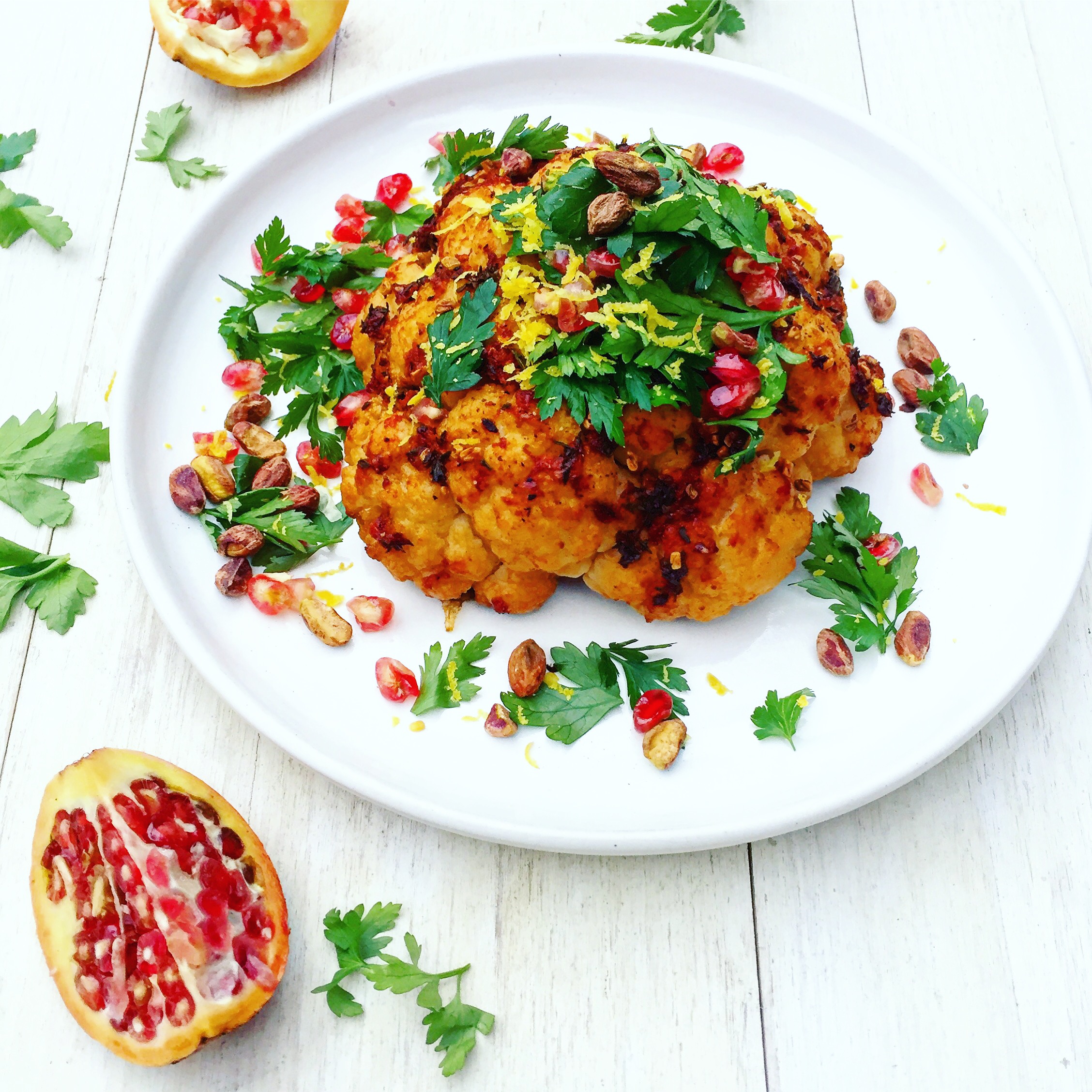
Whole baked cauliflower
A couple of months ago, I was asked to do the cooking for a women's leadership retreat taking place in late December. Although I've never actually cooked for a crowd this size before, my "can do" attitude stepped in and off I went to design a 3-day menu.
Menu design complete, I sent off my quote but soon realised that I should probably practice the dishes that sounded so good on paper. That's when disaster no. 1 occurred.
One of the vegetarian dishes uses jackfruit in lieu of slow cooked lamb shoulder. Jackfruit, or the king of fruits, is an Asian fruit that shreds/ pulls apart just like slow roasted meat. Sounds great on paper, except it's super hard to obtain outside of Asia and I seem to have forgotten just how bad it smells. 30 minutes in the oven and my entire house was covered in the gentle aroma of exploding sewers.
So, to avoid evacuating the retreat, that recipe had to be swapped for something a little friendlier to the nostrils.
This whole baked cauliflower is what followed. It should serve 2-4 people dependent on the size of cauliflower you use but I shamelessly ate the whole thing in a sitting. Basically, it's insanely tasty and I wouldn't want you to miss out so here is the recipe.
Ingredients (Serves 2)
1 large cauliflower, leaves removed and stalk cut back
1 lemon, juice and zest
Leaves from a small bunch of parsley
seeds from 1/2 pomegranate
40g pistachios
black pepper to season
For the flavour paste:
3 cloves of garlic, crushed
leaves from 4 sprigs of thyme
2 tablespoons of rapeseed oil
1 teaspoon of smoked paprika
1/2 teaspoon fenugreek
1/4 teaspoon sea salt
Method:
Preheat the oven to 160 degrees C.
Mix together the flavour paste ingredients and rub the mixture over the cauliflower.
Put the cauliflower in a casserole dish, squeeze over the juice of a lemon and season with black pepper. Pop the lid on the casserole and bake in the oven for an hour.
Take the lid off and bake for a further 15 minutes. Put the pistachios on a baking tray and toast in the oven for 15 minutes.
Remove the cauliflower from the casserole and cut into two pieces.
To serve, put half a cauliflower on a plate, sprinkle over a generous pinch of lemon zest, a small handful of parsley leaves, pomegranate seeds and pistachio.
The foolproof guide to a healthy Christmas - kind of

December, the month of Christmas, is a wonderful collection of seeing friends, office parties and festive family gatherings. It is also that time of the year when nutrition becomes an obsolete trade, well kind of.
Having lost count of how many times I've been asked to write about how to have a "healthy" Christmas or how to stop festive weight gain, I thought I'd take to this blog with some foolproof pointers. So here is what I came up with:
1. Don't have a health conscious Christmas
Yes, I'm registered nutritional therapist. Yes, my job is to make people healthy and tell them to eat more vegetables. BUT, no, I don't want you to have a health conscious Christmas.
You see, there is more to staying healthy than just food. Social circles and human connections are just as important.
I realise this sounds a bit hippiefied so let me explain:
You go to your aunt's/ uncle's/ sister's/ brother's (delete as appropriate) house, they spent all day cooking up a storm, went to great expense to purchase some fabulous alcoholic beverages, you know because it's Christmas so why not, and you turn up to announce that you are in fact gluten free, paleo and don't really fancy a drink.
The rest of your family conversations will revolve around a. has she/he gone mad? b. she/he has an eating disorder c. how can we convince her/him that this isn't a good idea. So for the remainder of that day your newly found eating habits will be questioned until you either finally give in or can't take anymore and end up downing a bottle of Christmas plonk.
The moral of this story is: don't be a party pooper. Drink the wine, eat the food and make the most of having a good time with people that have made an effort to be with you. It's better to get to January a couple of pounds heavier and with lovely new memories of great family gatherings or parties where you didn't feel restricted.
Live it up, laugh and be merry.
2. Don't ignore the veg
You won't be judged for dodging an overcooked brussel sprout but ignoring vegetables altogether is a mistake. Vegetables are where the majority of essential nutrients come from and putting some on your plate when they are in front of you anyway isn't such a struggle.
Besides, those veggies are the difference between having an OK hangover or a "can't cope with this day" style epic hangover.
Indol-3-carbinols found in cruciferous vegetables, such as broccoli, kale, cabbage (and brussel sprouts), can speed up detoxification and generally give your liver a hug when it needs it.
3. Drink up
Before you get carried away and think a nutritional therapist is encouraging more alcohol, let me just be clear: I meant drink water.
Keeping hydrated is especially important when the unavoidable combination of salt, protein and alcohol are present. Either drink a glass of water following every alcoholic drink or ensure that you get your 8 glasses of water in somehow.
You won't just have more energy this way, but you'll also avoid putting too much pressure on your kidneys and since you need your kidneys to stay healthy, it's best if you look after them.
The end!
Have a wonderful Christmas and make the best of spending time with your friends and family.
Just in case you get too carried away, check out the Upgrade your Health package in January. It may just help you shift that excess weight.
Sweet potato and carrot soup
Whether you like yours lightly spiced, chunky or creamy, bowls or warming soup are a staple lunch option in the winter months.
Aside from the warmth, they come with so many advantages: you can use up those sad looking veggies from the fridge; made correctly they are super nourishing; they are easy to transport and cheap to make.
As a side note, no one has ever complained about a warming bowl of soup, unless of course you are Charlie Bucket and have just been presented with another portion of cabbage soup
but seeing as he is a fictional character, that doesn't really count.
This carrot and sweet potato soup is lightly spiced with ginger, turmeric and cumin to keep those pesky cold and cough causing germs away. Using a good quality bone broth for the base will deliver additional gut healing benefits but if you don't have access to this then some veggie stock will the trick.

Ingredients (Serves 2)
1 onion, roughly chopped
2 medium carrots, peeled and roughly chopped
2 small or 1 large sweet potato, peeled and roughly chopped
500ml good quality chicken broth or vegetable stock
1 clove of garlic, roughly chopped
1-2cm piece of ginger, peeled and sliced (the ginger adds a spicy note so only use a 1cm piece if you aren't a fan of spice)
1 teaspoon of cumin seeds
1/4 teaspoon turmeric
1/4 teaspoon sea salt
freshly ground black pepper to season
1 teaspoon of coconut oil
Fresh herbs and seeds to garnish (optional)
Method:
Heat a pan on a medium heat, add the cumin seeds and toast for a minute until fragrant. Tip the seeds into a bowl and set aside.
Put the pan back on the heat, add the coconut oil and onions and cook until the onions have softened (5 minutes approximately). Stir in the garlic, ginger, turmeric, salt, toasted cumin seed, season well with black pepper and cook for a further minute.
Throw in the carrots and sweet potato and pour in the stock. Stir well.
Pop a lid on the pan, turn down the heat to low and cook for 20-30 minutes or until the vegetables have softened.
Take the pan off the heat and blend to the desired texture.
To serve, divide the soup between two bowls and top with fresh herbs and seeds.
Everyday staples to kick that cold
Cold and flu season may be upon us but that doesn’t mean you should succumb to snot fuelled misery.
With the average person suffering over 200 colds in their lifetime, lasting 9 days an episode, that’s a lot of sneezing, coughing and sore throats to deal with.
The good news is, there are a whole host of everyday kitchen staples that can reduce those cough and cold symptoms, all without having to step out of the house.
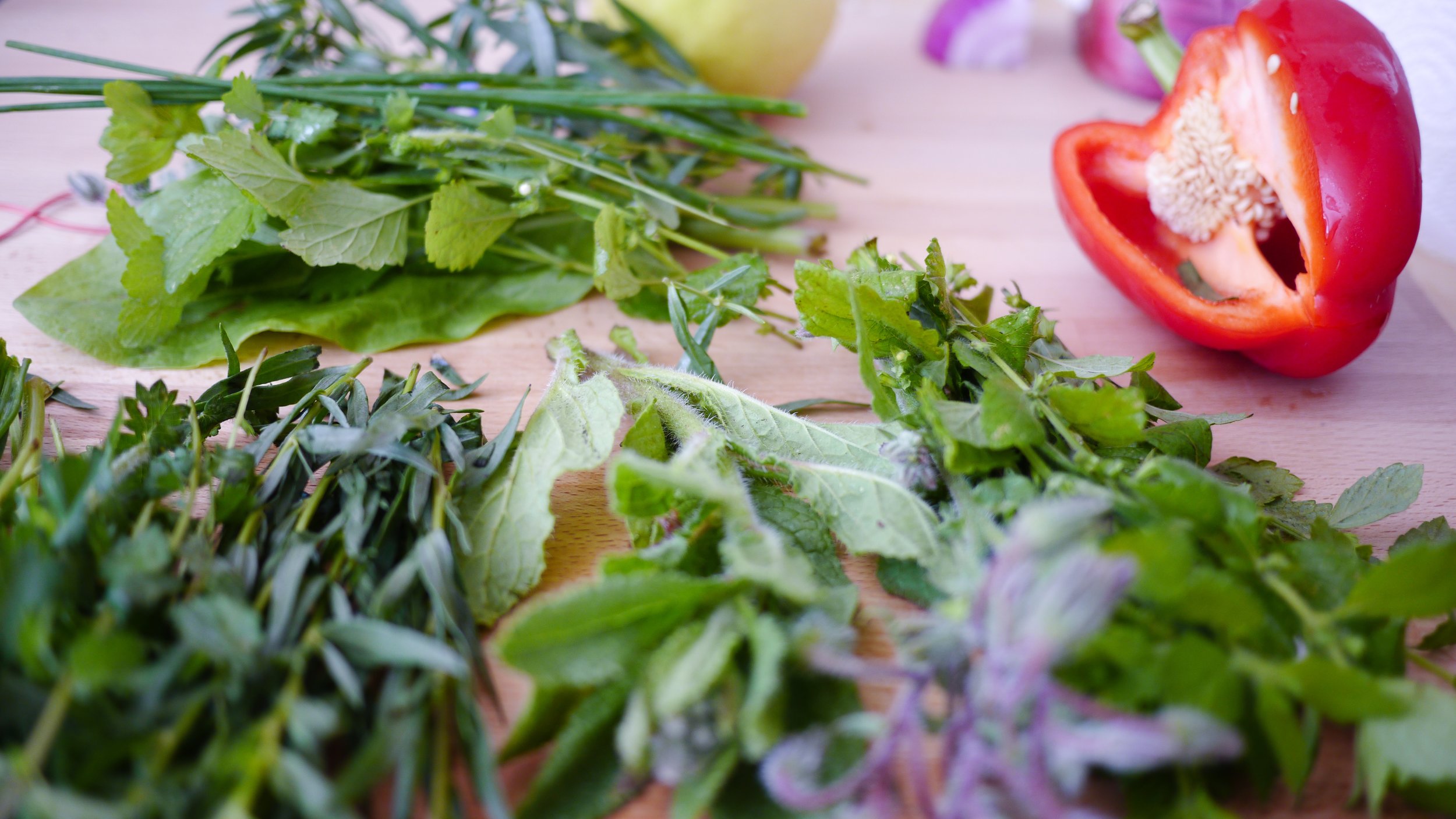
Fresh Herbs
A recent study found thyme, oregano and basil to be effective against bacteria that causes the sore throat (1) and the benefits of these herbs don’t stop there.
Thyme has been shown to halt the growth and spread of 120 different bacteria and viruses, especially those that are responsible for cough and cold symptoms (2).
What was even more surprising is that thyme was effective at stopping even the antibiotic-resistant bacteria (2). This is kind of a big deal since antibiotics are becoming useless thanks to antibiotic resistant bacteria.
An essential oil found in oregano produced similar results against the sore throat causing streptococci bacteria according to a study by the Polytechnic University of Marche, Italy (3).
Another study by the Medical University of Lodz, Poland showed basil to be effective against the bacteria that lead to upper respiratory tract infections (4).
For the most potent combination, chop up any of these herbs, cover with cold water and boil on the lowest setting, with a lid on the pot, for 20 minutes (5).
If this seems like hard work, just add a sprig of fresh thyme, some basil or oregano to your usual hot water and lemon and drink it like tea.
Garlic
As well as keeping vampires away, garlic may be effective at reducing cold and flu severity.
A recent study by the University of Florida indicated that garlic can reduce the number of symptoms experienced and the overall duration of a cold (6).
During a separate study, participants fed a meal of bread, butter and garlic (mmm, delicious) exhibited greater immune stimulation, meaning garlic kicked their immune system up a notch (7).
Yes, you may not smell that great by eating raw garlic but in the hours of snot fuelled need, it could be an effective cold and cough fighting measure.
Berries
Colour pigments found in berries may reduce cold, cough and sore throat severity by 40% according to research by the University of Auckland (8).
A large handful of fresh or frozen berries added to a smoothie or popped on top of some warming porridge is enough to rev up your immune system.
Green & white tea
Studies carried out by Pace University found white and green tea to be effective agents against certain bacteria and viruses. In specific, they reduce the efficacy of the sore throat causing Streptococcus bacteria (9).
If you are sick of the feeling of swallowing razor blades, put your kettle on and brew a nice cup of green or white tea. A couple of cups a day will go a long way.
Chilli
If you aren’t a fan of spicy food, this information may not be entirely applicable, however, a component of chillies can stop the spread of antibiotic resistant bacteria (10). In real terms, this means fewer body aches and pains and less fever.
You can’t exactly sweat your cold out but eating chillies provides the right kind of heat to assist with germ fighting.
A spicy curry is a good option to add chilli into your day, unless of course, you fancy your own one man chilli challenge.
References:
(1) Mehreen A, Waheed M, Liaqat I, Arshad N (2016) Phytochemical, antimicrobial, and toxicological evaluation of traditional herbs used to treat sore throat. BioMed Research International, doi:10.1155/2016/8503426.
(2) Sienkiewicz M, Łysakowska M, Denys P, Kowalczyk E (2012) The antimicrobial activity of thyme essential oil against multidrug resistant clinical bacterial strains. Microbial Drug Resistance, doi: 10.1089/mdr.2011.0080.
(3) Magi G, Marini E, Facinelli B (2015) Antimicrobial activity of essential oils and carvacrol, and synergy of carvacrol and erythromycin, against clinical, erythromycin-resistant Group A Streptococci. Frontiers in Microbiology, doi: 10.3389/fmicb.2015.00165.
(4) Sienkiewicz M, Łysakowska M, Pastuszka M, Bienias W, Kowalczyk E (2013) The potential of use basil and rosemary essential oils as effective antibacterial agents. Molecules, doi: 10.3390/molecules18089334.
(5) Martins N, Barros L, Santos-Belga C, Silva S, Henriques M, Ferreira IC (2015) Decoction, infusion and hydroalcoholic extract of cultivated thyme: antioxidant and antibacterial activities, and phenolic characterisation. Food Chemistry, 167: 131-137.
(6) Percival SS (2016) Aged garlic extract modifies human immunity. The Journal of Nutrition, doi: 10.3945/jn.115.210427.
(7) Charron CS, Dawson HD, Albaugh GP, Solverson PM, Vinyard BT, Solano-Aguilar GI, Molokin A, Novotny JA (2015) A single meal containing raw, crushed garlic influences expression of immunity- and cancer-related genes in whole blood of humans. The Journal of Nutrition, 145(11): 2448–2455.
(8) Somerville VS, Braakhuis AJ, Hopkins WG (2016) Effect of flavonoids on upper respiratory tract infections and immune function: a systematic review and meta-analysis. Advances in Nutrition, 7: 488-497.
(9) American Society For Microbiology (2004) White tea beats green tea in fighting germs. ScienceDaily, Accessed: https://www.sciencedaily.com/releases/2004/05/040526070934.htm.
(10) Marini E, Magi G, Mingoia M, Pugnaloni A, Facinelli B (2015) Antimicrobial and anti-virulence activity of capsaicin against erythromycin-resistant, cell-invasive group A streptococci.
Quisque iaculis facilisis lacinia. Mauris euismod pellentesque tellus sit amet mollis.