Save yourself the guilt of overindulgence by making this delicious frozen yoghurt.
Read moreSalmon, sweet potato mash & greens
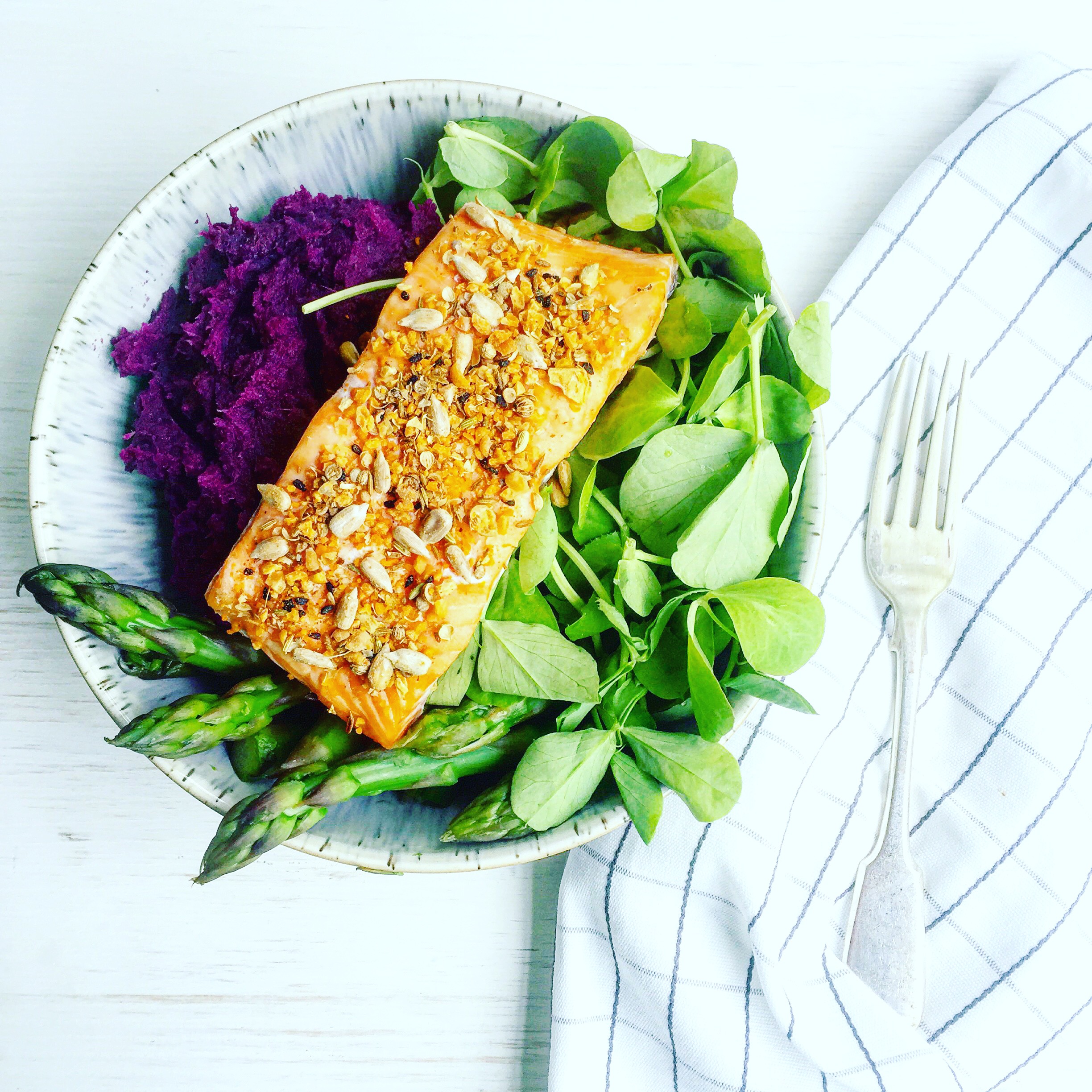
When in need of a nutrient boost, this trusted repertoire of fish, sweet potato mash and greens is what I rely on. This combination makes for a "well-balanced" meal.
So, what does "well-balanced" mean?
In any given day we need a certain amount of macronutrients (protein, carbohydrates and fats) as well as micronutrients (vitamins and minerals). A well-balanced meal contains all of these in the right proportions.
There is protein and fats in the fish and seeds and carbohydrates, vitamins and minerals in the sweet potato and greens.
Stick to half of your plate/ bowl as vegetables, 1/4 of the plate as protein and 1/4 of the plate as carbohydrates to achieve the optimum proportions of a well-balanced meal.
This combination makes a great lunch and dinner so double up the portions for a healthy lunch the following day.
Ingredients for 1:
1 medium sweet potato
1 teaspoon of extra virgin olive oil
1 lightly smoked salmon fillet
2 cups of any greens (I used asparagus and pea shoots)
sea salt & freshly ground black pepper
1/2 tablespoon of dukkah (optional) - (You can find dukkah in any Middle Eastern store and larger supermarkets. It is a spice mix containing roasted cumin, coriander seed, fennel and crushed hazelnuts or sunflower seeds.)
Method:
Preheat the oven to 180 degrees C.
Pierce the skin of the sweet potato with a knife and bake in the oven for 45 minutes, or until a knife goes through the fattest part with ease (you want it to be soft all the way through).
Remove it from the oven and allow it to cool slightly. Peel and mash with a fork.
Add the olive oil and season to taste with sea salt and freshly ground black pepper.
Wrap the salmon fillet in tinfoil or baking paper and bake in the oven for 15 minutes.
Steam or boil your greens lightly (obviously skip this if you are using salad).
To assemble, cover half of your plate in greens, a 1/4 with the sweet potato mash and top with the salmon. If you are using dukkah, sprinkle it over the salmon, if you aren't using it then season the salmon fillet with some freshly cracked black pepper.
Smokey chickpea salad
If salads don't fill you up, try adding some beans and pulses.
They are great sources of fibre as well as protein, all of which contribute to keeping you fuller for longer (or actually filling you up in the first place).
For this recipe, chickpeas are mixed with smoked paprika, tomato, tamari and ground coriander for a subtle hint of flavour. Balance it with a crunchy salad of fresh leaves and a honey mustard dressing add to sweetness and acidity.

Ingredients for 1 (multiply as required)
Chickpeas:
1 tin of chickpeas
1/2 teaspoon of smoked paprika
1/2 teaspoon of ground coriander
2 teaspoons of tomato paste
1 teaspoon of tamari or soy sauce
Honey mustard dressing
1 teaspoon of wholegrain mustard (ideally a sugar-free one)
1 teaspoon of honey
1 tablespoon of apple cider vinegar (or red wine vinegar)
1.5 tablespoons of extra virgin olive oil
1/2 bag of mixed leaves
1/2 little gem lettuce or any other crunchy lettuce variety
Method:
Preheat the oven to 180 degrees C.
Drain and rinse the chickpeas.
Mix the tamari, tomato, smoked paprika and ground coriander until it forms a paste.
Coat the chickpeas in the paste and pop them in the oven for 10-15 minutes.
For the dressing, whisk all of the ingredients until well combined (around 5 minutes).
Coat the salad leaves and lettuce in the dressing and top with the chickpeas.
Smokey super seeds
Get a daily boost of fibre, antioxidants and minerals by snacking on seeds.
Check out my previous post to discover why snacking on seeds is a smart move.
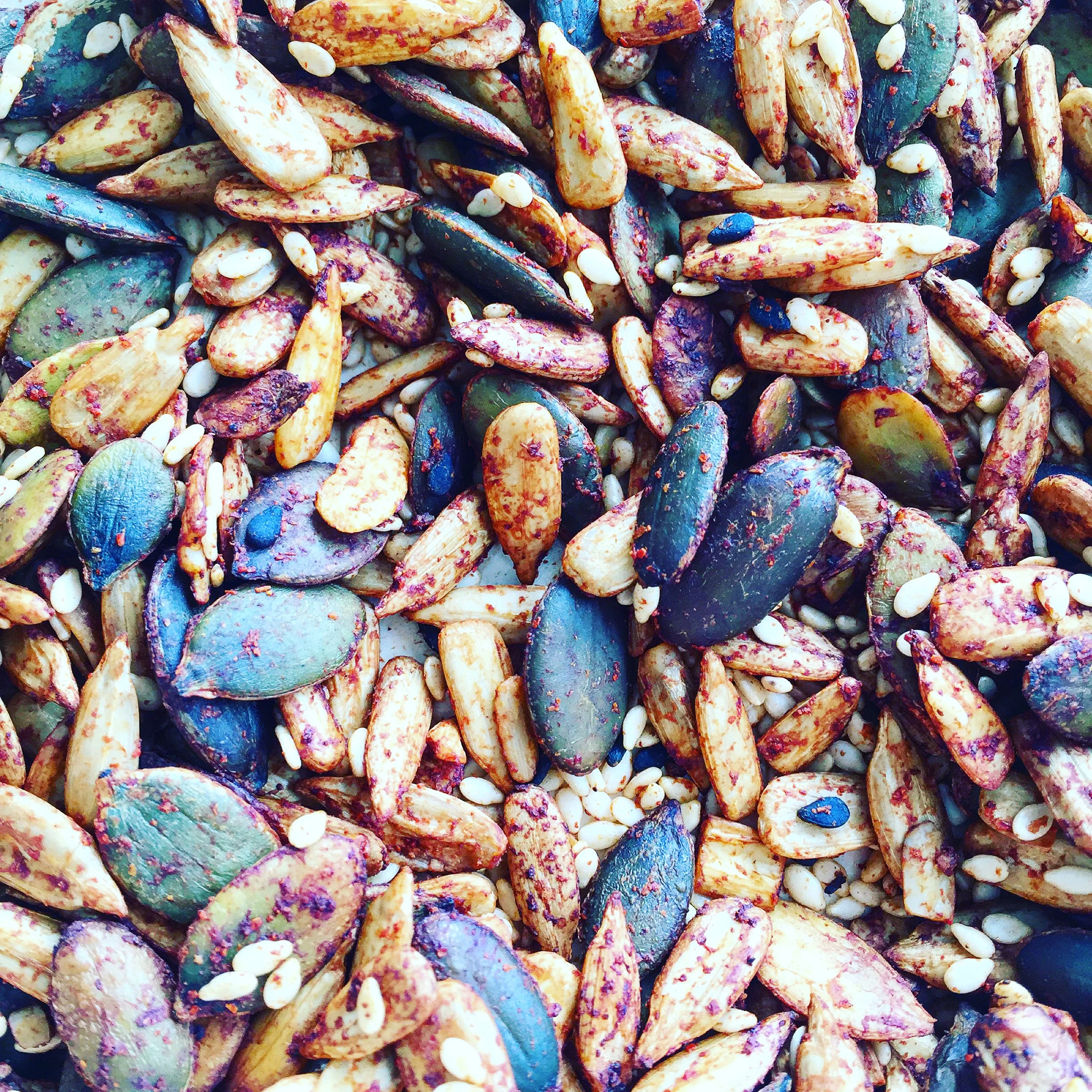
For this recipe, I combined pumpkin, sunflower and sesame seeds with smoked paprika for a hint of bacon-like flavour.
Try them, they make an amazing afternoon snack and also go well sprinkled on salads.

Ingredients:
1/2 cup each of pumpkin & sunflower seeds
1/4 cup sesame seeds
1 tablespoon tamari or soy sauce
1 teaspoon of tomato paste
1 teaspoon of smoked paprika
A pinch of cayenne pepper (optional)
Method:
Preheat the oven to 180 degrees C.
Combine the tamari, tomato paste, paprika and cayenne (if using). It should form a paste.
Coat the seeds in the paste by stirring it all together until well combined.
Put the whole thing on a baking tray and bake for 10-15 minutes. Give it a good stir every 5 minutes to ensure the seeds toast evenly.
Why snacking on seeds is a smart move
Our avian friends have been onto this for years and it turns out they aren't wrong: seeds make a delicious and fulfilling snack.
Thanks to science, there is also convincing evidence that snacking on seeds is a smart move.
Let's take a non-nerdy look at some of the data:

Blood sugar
When it comes to weight loss, managing your blood sugar is one of the most important aspects.
Here is why: when you eat sugar, your body goes into a frenzy of trying to figure out what to do with it. Do we use it, do we store it or do we convert it to fat? Whilst there is a sugar spike in your system, fat burning or using fat for fuel doesn't happen.
Eating seeds doesn't spike your blood sugar so fat burning can still take place.
In fact, a meta-analysis found that those who eat pulses and seeds tend to be slimmer(1).
Fibre
Seeds are great sources of fibre.
Increasing dietary fibre consumption has so many benefits. To name a few, it reduces insulin resistance(2) (this is important if you've been overdoing the sugar), staves off constipation(3), improves digestive function(4) and can help to reduce cholesterol(4) as well as blood pressure(4).
Antioxidants
Antioxidants work by reducing damage to cells.
Imagine this: you are about to eat some sweets. Your good friend comes along and takes them out of your hands because you are on a diet. Your friend just saved you from doing some damage. Antioxidants work a little bit like this too.
Pumpkin seeds contain an especially diverse range of antioxidants.
Minerals
Seeds are rich sources of minerals, including zinc and magnesium.
Zinc plays a vital role in the immune and nervous systems(5), great if you want to avoid that office cold.
Sadly, zinc is also difficult to obtain from food, especially if you are vegan, unless of course you eat some seeds.
How much should you have?
A handful of a combination of pumpkin, sunflower and sesame seeds makes the ideal snack.
This blend ensures you obtain a good range of minerals, antioxidants and fibre.
Seeds are also delicious sprinkled on salads, your morning porridge or added to smoothies.
Try Munchy Seeds for a delicious portable option or read the next post for a tasty super seed recipe.
References:
1. Kim SJ, de Souza RJ, Choo VL, Ha V, Cozma AI, Chiavaroli L, Mirrahimi A, Blanco Mejia S, Di Buono M, Bernstein AM, Leiter LA, Kris-Etherton PM, Vuksan V, Beyene J, Kendall CW, Jenkins DJ, Sievenpiper JL (2016) Effects of dietary pulse consumption on body weight: a systematic review and meta-analysis of randomized controlled trials. The American Journal of Clinical Nutrition, 103(5):1213-23.
2. Breneman CB, Tucker L (2013) Dietary fibre consumption and insulin resistance – the role of body fat and physical activity. British Journal of Nutrition, 110: 375-383.
3. Ip KS, Lee WT, Chan JS, Young BW (2005) A community-based study of the prevalence of constipation in young children and the role of dietary fibre. Hong Kong Medical Journal, 11: 431-436.
4. Mackowiak K, Torlinska-Walkowiak N, Torlinska B (2016) Dietary fibre as an important constituent of the diet. Postepy Higieny i Medycyny Doswiadczalnej, 70:104-109.
5. Rink L, Gabriel P (2000) Zinc and the immune system. Proceedings of the Nutrition Society, 59: 541-552.